The Brutalist: The Forces Behind the Form

Photo via Universal Pictures
by Laura Sitkin
While working on the identity for Toulouse Millworks, a family-based business whose roots stretch back more than two centuries, we thought a lot about lineage, craft, and what it means to inherit a way of making — not just a style, but a responsibility. Those themes were resonant when I watched the film The Brutalist. I went into the movie expecting concrete, sculptural forms, and bold lines — a cinematic homage to the architectural movement whose name has become aesthetic and cultural shorthand. Instead, I found something unexpectedly personal.

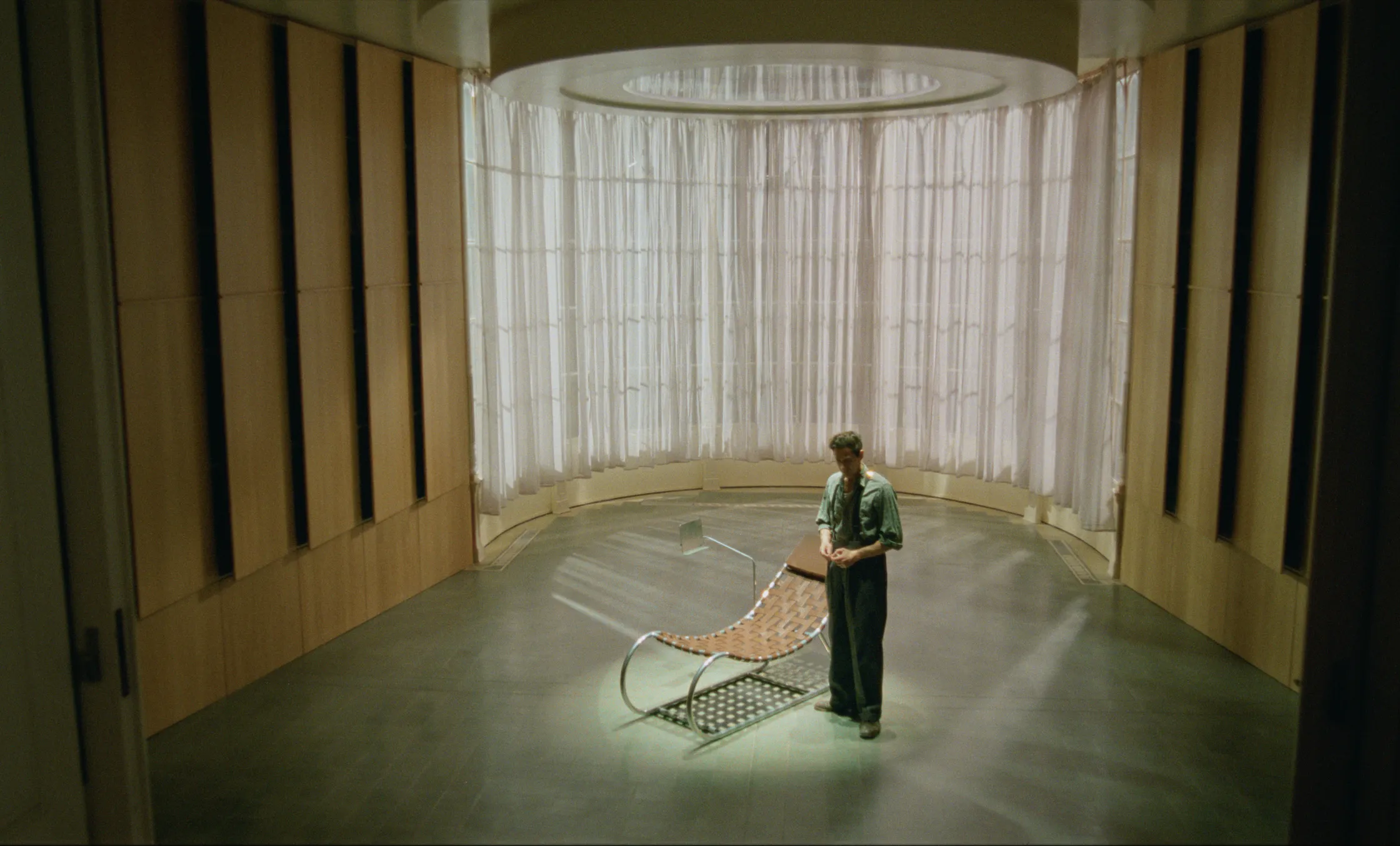
The Brutalist is a film about an architect, but it also investigates what shapes a person long before they ever shape a building: ambition that survives war, loss, poverty, and dislocation. It’s about how ethnicity, money, and power quietly (or loudly) contour a life, and what we carry with us when we leave everything behind.
The fictional Hungarian architect László Tóth, who flees war-torn Europe and arrives in postwar America to start over, is played with tremendous restraint by Adrien Brody. Tóth is a visionary, a genius, and a metaphor for the movement. The film barely reveals his work, though the few buildings we do see are massive and monolithic and speak volumes about his life. The real weight comes from what’s behind them: compromise, grief, trauma, and sometimes grace. The architecture is less about form than it is about force — what’s imposed, and what emerges in spite or because of it.
I happened to arrive late to the theater and ended up in the front row, nearly eye to eye with the screen. The uncomfortably close perspective made the first scene in particular almost unbearable in its beauty. As Tóth’s ship pulls into New York Harbor and the Statue of Liberty looms into view, a friend shakes him from his sleep and urges him on deck. The camera lurches with the ship, and the statue, already larger than life, tilts into frame like a vision. It’s a symbol we all know too well. But in that moment, so close to the screen, it felt more intimate and vulnerable than symbolic.

My grandparents and great-grandparents took that same route, fled similar terrors, and arrived — alone, exhausted, poor, hopeful — to that same port. It was a reminder that what we create begins in memory, in the stories we carry with us and the ones we choose to tell. Many of those stories went unheard because many of our ancestors were unable to read or write. We place a high value on clarity, accessibility, and giving form to ideas. Our work leans toward restraint, rigor, and honesty rather than decoration. Thought Partner’s emphasis on partnership comes from our inheritance: an understanding that survival and the ability to thrive are communal, not individual. In that sense, our work is an ongoing answer to a question we carry with us: What did they endure so that we could do this work?
As designers, we talk a lot about systems, symbols, and structures. But The Brutalist asks us to consider something else: how every act of making (a building, a brand, or a life) is shaped by histories we can’t always see. And how design, at its most honest, doesn’t just reflect an identity. It reveals what it took to build one.
© Laura Sitkin